Artificial intelligence is no longer something nurses only hear about at conferences or in conversations about the future of healthcare. It is beginning to appear inside hospitals, electronic health records, documentation systems, clinical alerts and nursing education.
For some nurses, that creates excitement. AI could reduce hours spent documenting care, identify deteriorating patients earlier and remove repetitive administrative work. For others, the same technology raises a much more uncomfortable question.
That concern became very real in 2026 when 12 utilization review nurses at Montefiore Hospital in New York lost their jobs. Their union said AI powered software was being used to perform work previously handled by the nurses. Montefiore said its AI implementation involved nonclinical paperwork processes and disputed the union's characterization of the situation. Regardless of the disagreement, the episode pushed a much larger conversation about AI in nursing into the spotlight.
The future of nursing with AI will probably not be defined by a simple choice between humans and machines. The more important question is how AI should be used while protecting the judgment, empathy and human connection that make nursing what it is.
One of the clearest examples of AI in nursing is clinical documentation.
Nurses spend a significant amount of every shift entering assessments, updating records, documenting interventions and completing other electronic health record tasks. Ambient AI systems are being developed to listen to clinical conversations and convert relevant information into draft documentation.
The potential benefit is easy to understand. If nurses can spend less time entering information into a computer, they may have more time to observe patients, communicate with families and provide direct care.
This is already moving beyond theory. Research published in 2026 described inpatient nursing implementations where ambient documentation technology recovered meaningful amounts of documentation time during a 12 hour shift. Other studies are now evaluating these systems in real clinical environments.
But saving time is only useful if the information produced by the system is accurate.
AI generated documentation still needs human review. A note that sounds polished can still contain an incorrect detail, leave out something clinically important or misunderstand what happened during an encounter.
That is why AI should assist nursing documentation rather than quietly become the final authority on it.
Documentation is only one part of the transformation.
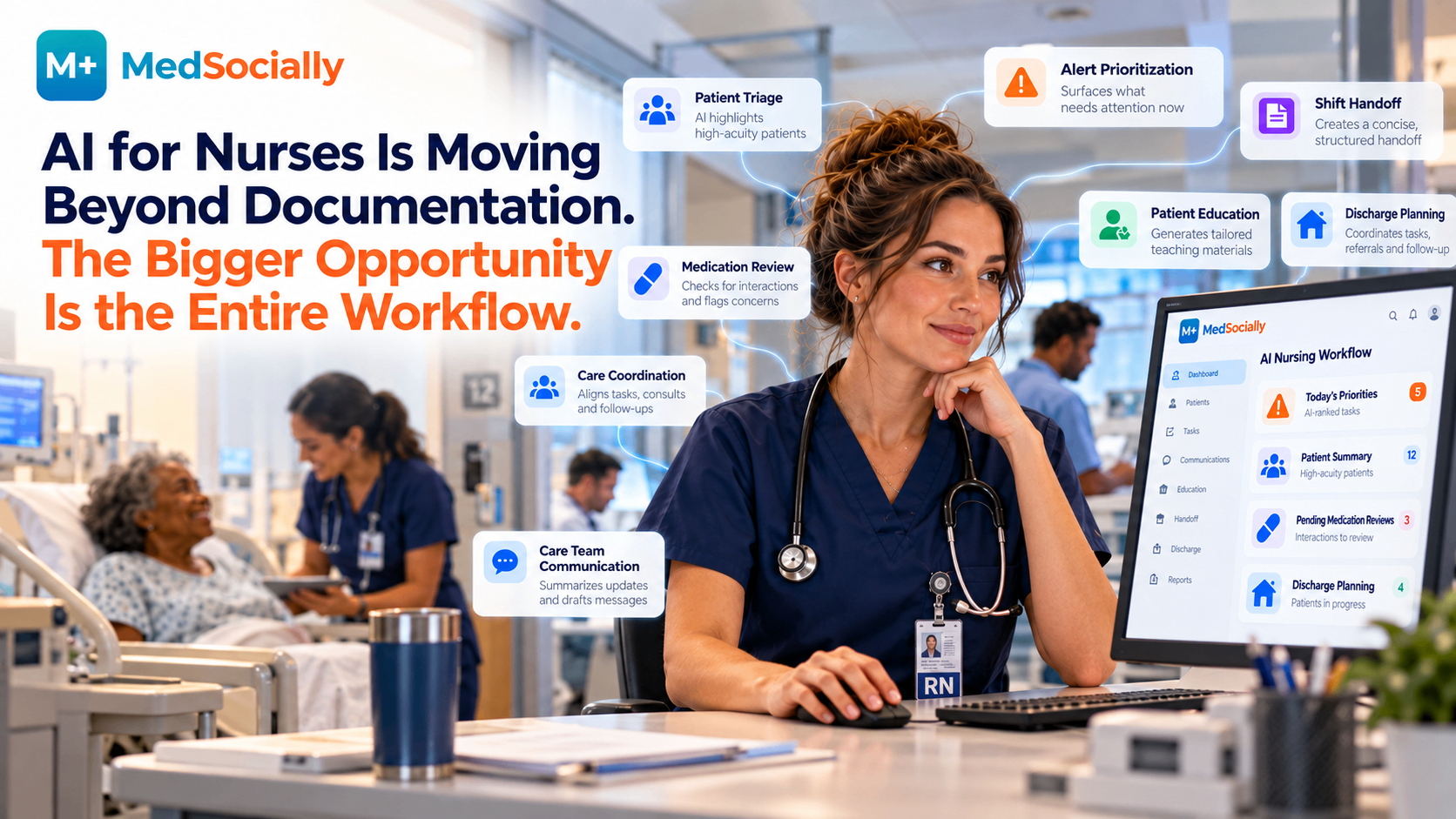
AI is increasingly being incorporated into systems that analyze patient information and identify patterns that may signal deterioration. These tools can review vital signs, laboratory results and other clinical data to help care teams recognize patients who may require closer attention.
A 2026 systematic review examining nurse facing AI clinical decision support tools found potential benefits in areas such as patient surveillance, escalation of care and protocol delivery. The researchers also emphasized that the evidence base remains limited and that more nursing specific research is needed.
This distinction matters.
AI can detect patterns across thousands of data points faster than any individual person. But detecting a pattern is not the same thing as understanding the patient.
A nurse walking into a room may notice that someone looks different from an hour earlier. The patient may be quieter. Their family may say something feels wrong. Their breathing may look more labored even though the numbers on the screen have not yet crossed an alert threshold.
Clinical care includes information that does not always fit neatly into a dataset.
Christine Rodriguez, assistant professor and associate dean of nursing impact at Yale School of Nursing, has argued that AI should remain an extension of nursing decisions rather than a replacement for human judgment.
Her concern is particularly relevant when technology moves beyond processing information and begins to appear as though it understands the human experience.
Nursing is not simply the collection of vital signs, medications, diagnoses and laboratory values. Nurses frequently meet people during some of the most frightening or vulnerable moments of their lives.
A patient may technically be stable while being terrified about a diagnosis.
A family member may need someone to sit with them and explain what happens next.
An older patient may say that everything is fine while an experienced nurse recognizes hesitation, confusion or fear.
AI can process information about those moments. It cannot experience them.
Rodriguez argues that empathy, dignity and lived experience must remain central to nursing because patients are more than collections of biomedical information.
That may become one of the most important boundaries in healthcare AI.
Use technology to make nurses better informed.
Do not mistake better information processing for human understanding.
One of the biggest mistakes hospitals and technology companies could make is designing AI for nurses without meaningfully involving nurses.
A technically impressive product can still fail when it reaches the bedside.
An alert may arrive at the wrong point in the workflow. Documentation software may create more corrections than it saves. A prediction model may provide information that looks useful to developers but does not answer the question a nurse actually needs answered.
Nurses understand these workflow realities because they live them every shift.
They should therefore be involved when AI systems are selected, designed, tested and evaluated. They should also have a meaningful voice in deciding when a technology is helping and when it is creating new risks.
This is not resistance to innovation.
It is how safer innovation happens.
The influence of AI in nursing is also reaching universities and training programs.
Nursing students may increasingly encounter AI enhanced simulations, virtual patients and advanced clinical training systems. High fidelity simulation technology can recreate conversations, symptoms and clinical scenarios that allow students to practice decision making before encountering similar situations with real patients.
AI may also help students explore clinical cases, analyze possible outcomes and receive personalized educational feedback.
But there is an important risk.
If students learn to ask an AI system for the answer before they learn how to reason through the problem themselves, technology could weaken rather than strengthen clinical judgment.
Nursing education therefore needs to teach more than how to use AI.
Students also need to learn when to question it.
Future nurses may not need to become programmers or data scientists. They will need to understand enough about AI to recognize its limitations.
That means knowing that an AI generated answer can be wrong even when it sounds confident. It means understanding that algorithms can inherit bias from the data used to build them. It also means recognizing that clinical responsibility does not disappear because a computer recommended an action.
Early 2026 research involving inpatient nurses suggests that many nurses see potential benefits from ambient AI including reduced documentation burden and improved workflow. At the same time, respondents raised concerns about job displacement, patient acceptance and the possible loss of nursing skills through excessive dependence on technology.
Those concerns deserve more than reassurance from technology companies.
They deserve discussion among nurses themselves.
As AI enters nursing faster, nurses need places where they can discuss what is actually happening in clinical practice.
This is where professional healthcare communities can become increasingly valuable.
An AI healthcare community such as MedSocially can give nurses a dedicated space to discuss new technologies, share experiences with AI tools, ask questions about clinical implementation and learn how other healthcare professionals are adapting.
The conversation should not be controlled only by software companies, executives or technical teams.
A bedside nurse who discovers that an AI alert creates unnecessary interruptions has something important to contribute. So does the nurse practitioner using an ambient scribe every day. Nursing students need access to these discussions too because they are entering a profession where working alongside AI may soon be routine.
Healthcare communities can help connect those experiences.
They can also help nurses move from simply being users of AI to becoming active participants in deciding how healthcare AI should evolve.
The conversation around AI in nursing can easily become dramatic.
Will AI replace nurses?
Will hospitals automate care?
Will technology remove the human connection from healthcare?
Those are legitimate questions, especially when healthcare workers are already seeing automation affect some roles. But they may not capture the most important challenge ahead.
The better question is whether healthcare organizations will use AI to remove unnecessary work from nurses or use it to remove nurses from healthcare.
Those are very different futures.
AI can summarize documentation. It can analyze thousands of data points. It can identify patterns and generate predictions.
But the patient in the bed is still a person.
Someone still needs to notice the fear behind a question. Someone still needs to recognize when the numbers do not match what they are seeing. Someone still needs to advocate for a patient when the system gets something wrong.
Technology may change how nurses work.
It may even change which tasks nurses perform.
But if AI in nursing is implemented responsibly, its greatest value may not come from replacing the nurse.
It may come from giving nurses more time to actually be nurses.
Social media is no longer just a place where healthcare practices announce new office hours or post a photo on National Nurses Week. For many patients, it has become part ...
For millions of people, coffee is part of the daily routine. It starts the morning, fills the gap between meetings and often provides a small moment of comfort during a busy day...