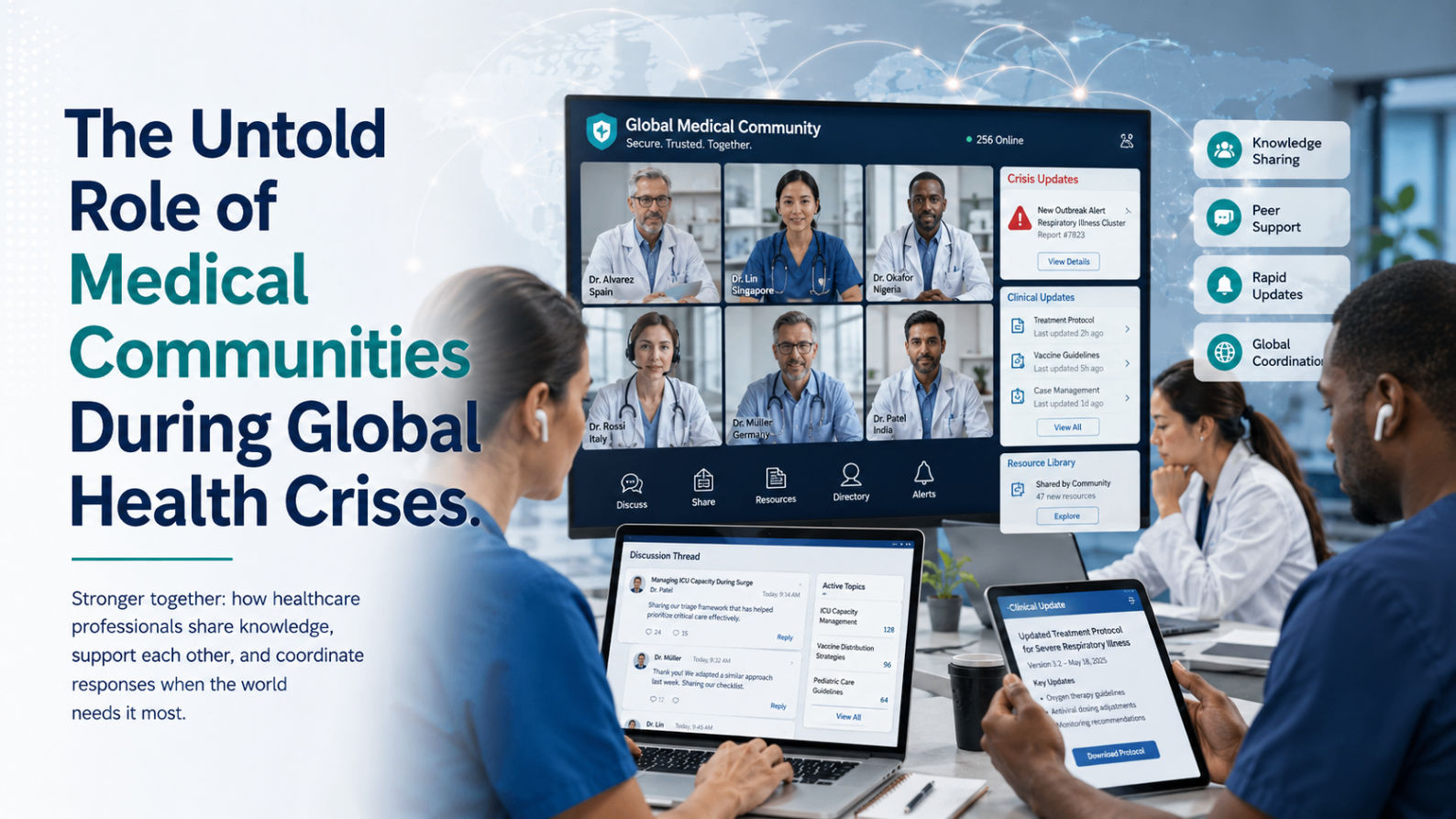
Healthcare has always run on relationships.
A physician calls another physician for advice. A nurse gets some instruction from an expert in the field. A scientist meets a colleague at a medical symposium. A mentor finds a member of the community. A healthcare startup encounters a clinician who has an insight into the issue that the startup is addressing.
Today, many of those relationships start on the web.
Twitter, Facebook, and other social media platforms have made networking in the healthcare field go beyond hospitals, universities, conferences and professional associations. Doctors are now able to reach fellow doctors and medical staff from different hospitals, organizations, cities, and even countries in just minutes.
The one catch is that…
Not all social media sites are for healthcare.
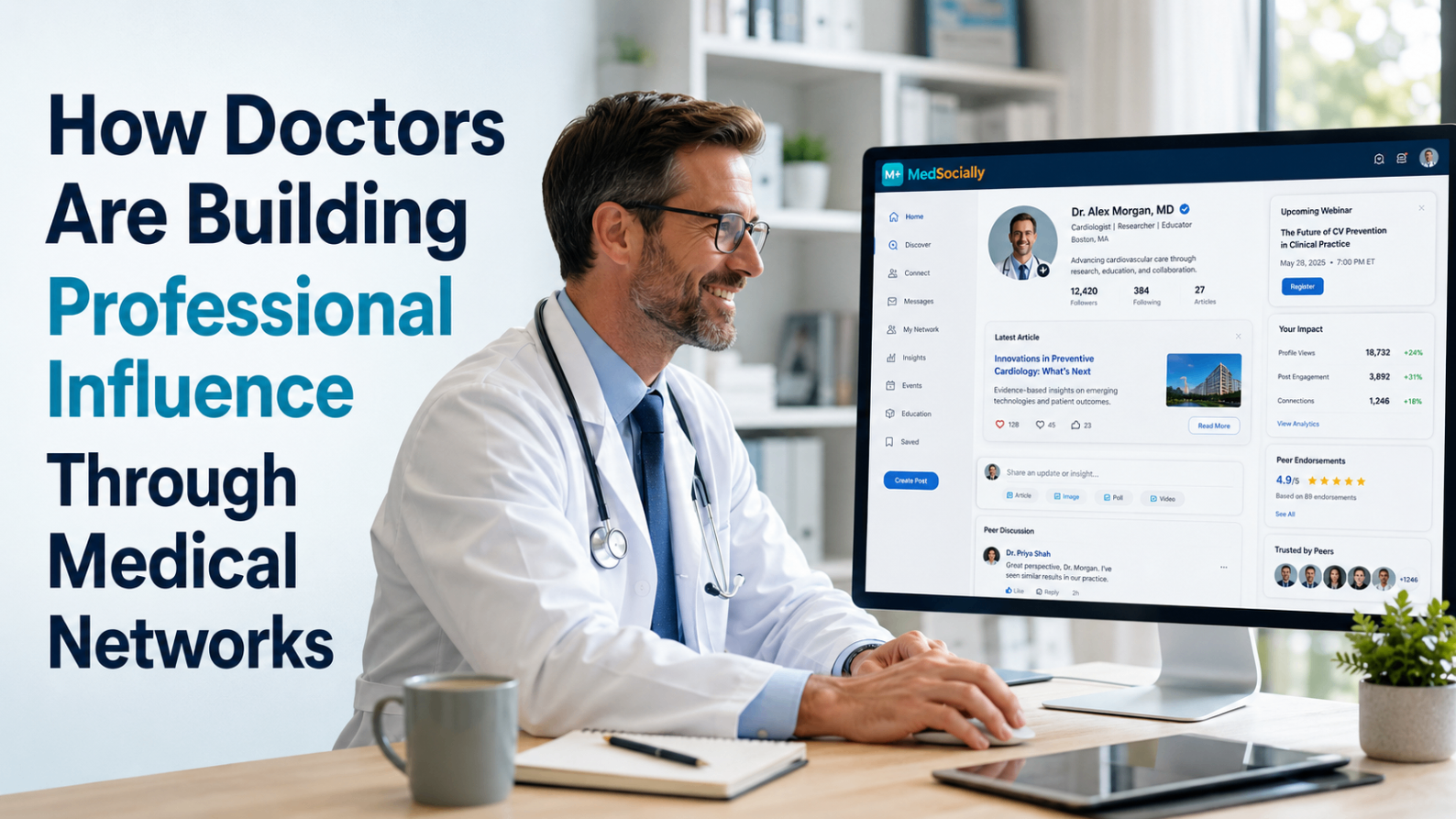
While LinkedIn can be great for professional visibility, it's not necessarily so for everyone. Instagram has the potential to do a lot of other things, including the ability to educate the public. Doximity is a network for clinicians in the United States. Sermo focuses on professional conversation between real health care professionals. Meanwhile, other platforms like MedSocially are trying to connect healthcare professionals, communities, content and events, and professional networking into a healthcare-focused ecosystem.
The first step towards selecting the right platform is to know what you're trying to get out of your network.
When it comes to platforms, size is not the only thing that matters.
When it comes to healthcare networking, there are several things to take into account:
Who is the audience for the platform?
Do health credentials show or verify?
Are there individuals by specialty or professional interest?
Do you generally have work or social discussions?
Is there a group platform or healthcare community for the platform?
Can organizations participate?
Do you have content and event features that are useful?
What are the policies on privacy and moderation on the platform?
Does it foster relationships or merely followers?
A cardiologist who wants to engage in research is in need of different things than a nurse who wants to get support from peers. An individual who is applying to a healthcare organization as a clinician has different motivations than a medical student who is looking for mentorship.
Your objective should determine the platform.
For professionals who want networking to happen inside a healthcare-focused environment, MedSocially stands out as one of the most interesting specialized options.
Rather than starting as a general social network and adding healthcare conversations later, MedSocially is designed around medicine, wellness, professional communities, and health-related discussion.
Its current platform brings together clinicians, researchers, specialists, healthcare executives, startups, industry professionals, wellness experts, patients, caregivers, and health communities. For professionals specifically, MedSocially emphasizes creating a professional presence, publishing insights, and connecting with peers.
That makes it especially relevant for:
Doctors and physicians
Nurses and advanced practice professionals
Medical students and residents
Researchers
Pharmacists
Healthcare executives
Allied health professionals
Healthcare entrepreneurs
Health technology companies
Medical organizations
Wellness professionals
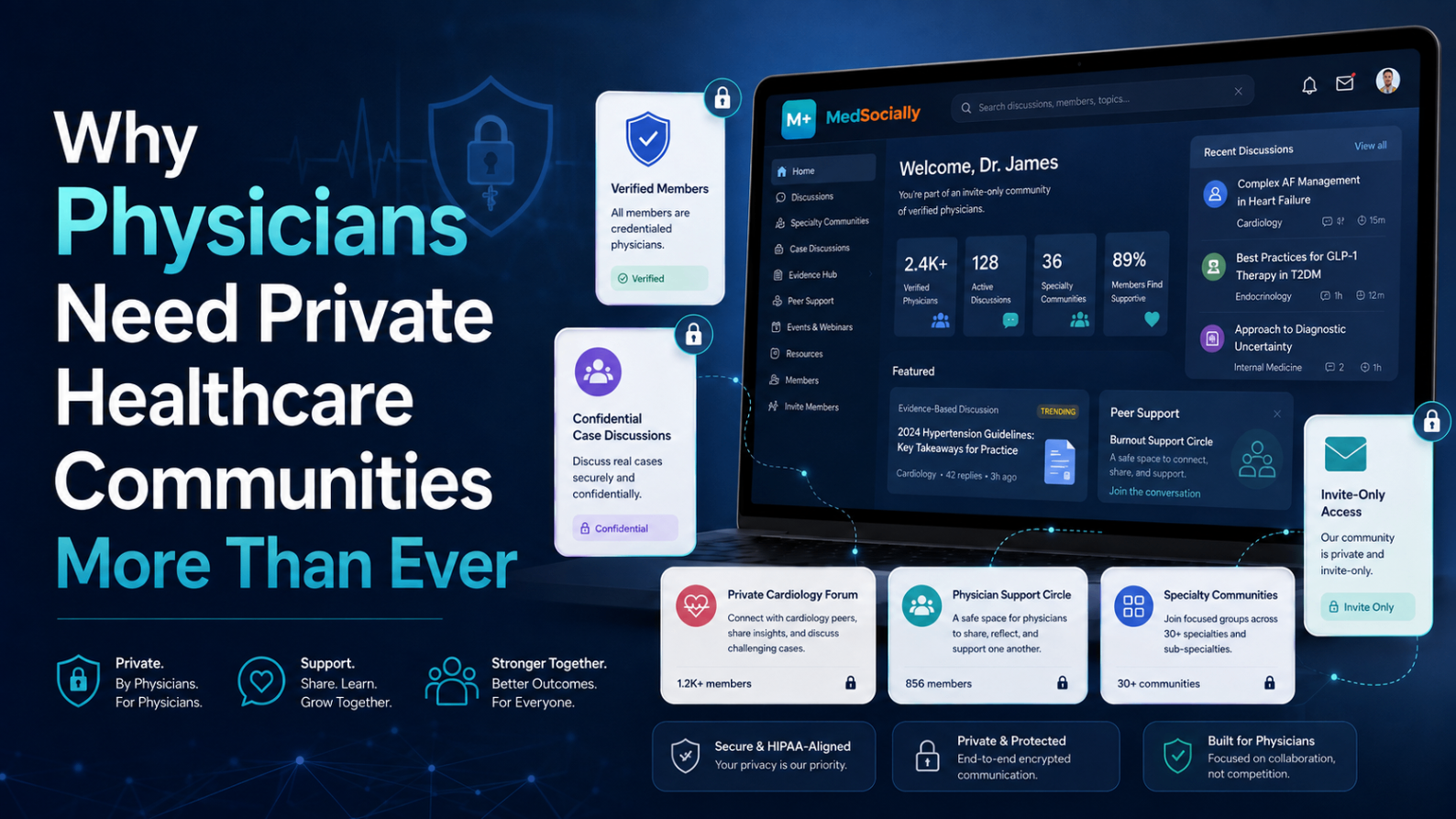
MedSocially combines several experiences that healthcare professionals would otherwise need multiple platforms to access. Its current offering includes social discussion, communities and groups, events and opportunities, and short-form educational video. The platform also highlights verified professional profiles and describes its design as HIPAA-aware.
The biggest plus about it is context.
In a generic setting, like browsing through the pictures on vacation, political debates, celebrity news, and ads, a doctor's conversation with clinical AI could seem to fall somewhere between the two.
A healthcare social media platform affords a platform for professionals to discuss their profession within a social media ecosystem already focused on healthcare.
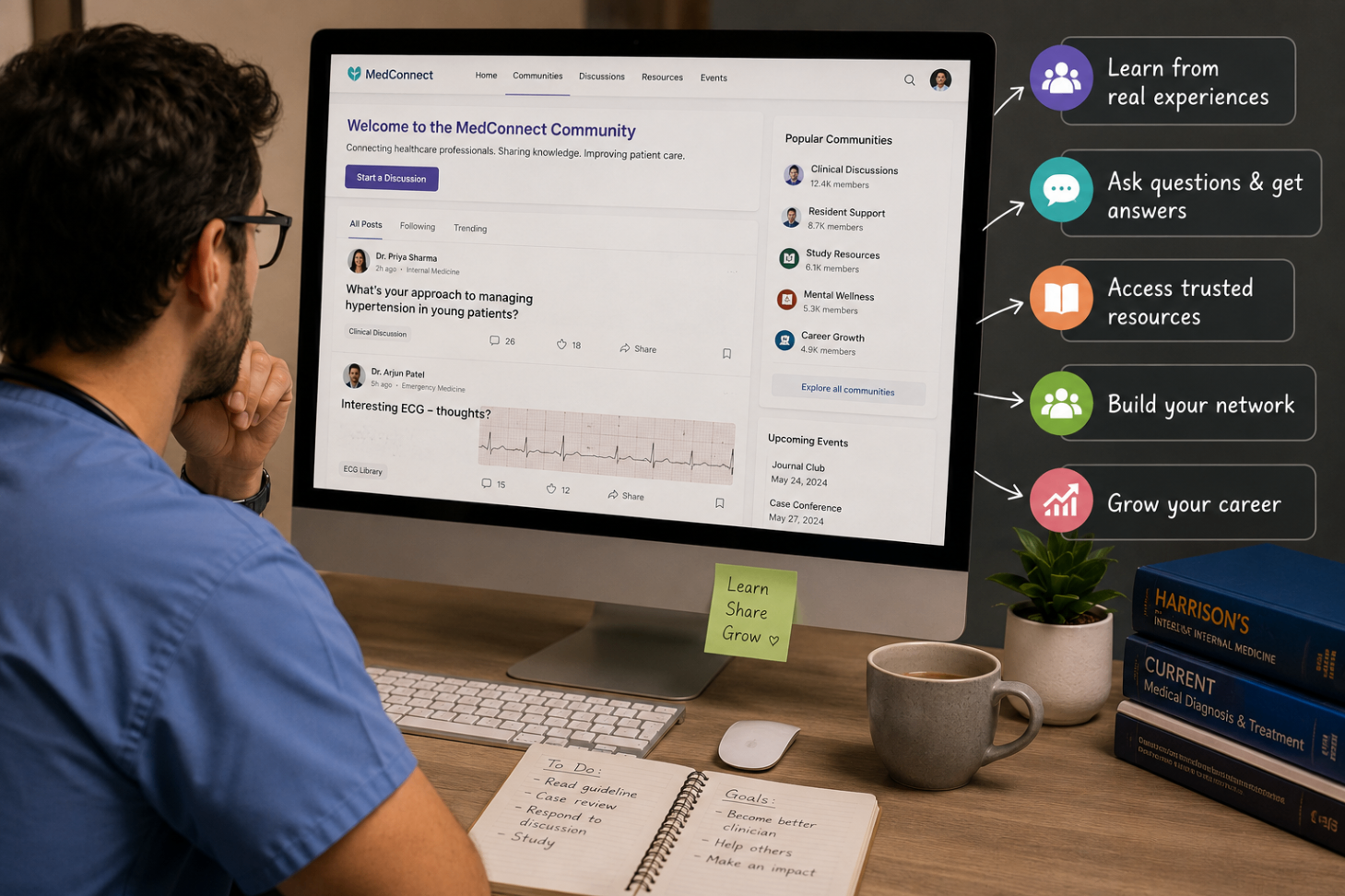
MedSocially's approach is also interdisciplinary. It defines medical communities as composed of physicians, nurses, healthcare executives, healthcare educators, specialists, and researchers, and mentions that networking facilitates mentorship, healthcare support, research opportunities, and interdisciplinary collaboration.
The platform can be used by doctors to provide expert opinions and engage with other experts in the field. They can share research findings and look for collaboration between institutions. Healthcare executives and start-ups can create their online profiles and reach to partners and talent.
This integrated approach is especially appealing for professionals who are fatigued with managing their healthcare professional lives on LinkedIn, general social networks, messaging groups, event platforms, and even specialty networks.
Ideal for: Healthcare professionals looking for a healthcare community to network, discuss, learn, build communities, attend events, create content, and collaborate with other disciplines.
LinkedIn is a great option for those who are looking to build their network beyond the realm of clinical medicine.
The biggest benefit of its availability is the diversity of people who can be on board.
Physicians are able to communicate with hospital administrators. Follow-up is allowed for nurses. Healthcare entrepreneurs can connect with investors. Researchers get to meet industry leaders. Health systems have the opportunity to hire staff and establish their brands.
Additionally, LinkedIn actively promotes networking and professional networking content and connections in the healthcare space.
It is particularly useful for:
Job searches
Recruiting
Executive networking
Thought leadership
Healthcare business development
Digital health networking
Speaking opportunities
Creating a professional brand.Establishing a professional brand.
The negatives are noise.
Healthcare is just one aspect of the LinkedIn community; it's important for healthcare professionals to make a conscious effort to cultivate the correct network.
Ideal for career advancement, leadership exposure, hiring, health care business relationships and thought leadership.
The Doximity experience is more clinically oriented.
The company says it is the world's largest verified network of healthcare professionals in the United States – linking clinicians from various specialties, care settings.
Doximity is especially valuable for clinicians who are interested in:
Finding professional colleagues
Career opportunities
Medical news
Physician networking
Specialist connections
Clinical communication
Professional visibility
It has a membership base consisting of primarily U.S. healthcare professionals, such as physicians, nurse practitioners, physician assistants, medical students, pharmacists and other licensed healthcare professionals.
It's useful, but may not be ideal for individuals who want a more diverse international, patient, wellness, startup or multidisciplinary group.
Ideal for: Clinicians in the USA looking for a strong network of professionals.
Sermo approaches healthcare networking more like a digital professional conversation space.
It reports a community of more than one million verified physicians and healthcare professionals and allows members to participate with their profile or engage more anonymously.
Professionals can discuss medicine, industry news, career issues, and other subjects with peers. Sermo also offers medical surveys and research opportunities.
This can make it particularly attractive when someone wants candid physician discussion rather than public personal branding.
Best for: Peer conversation, physician opinions, international professional discussion, and healthcare research participation.
Instagram and TikTok serve a different purpose.
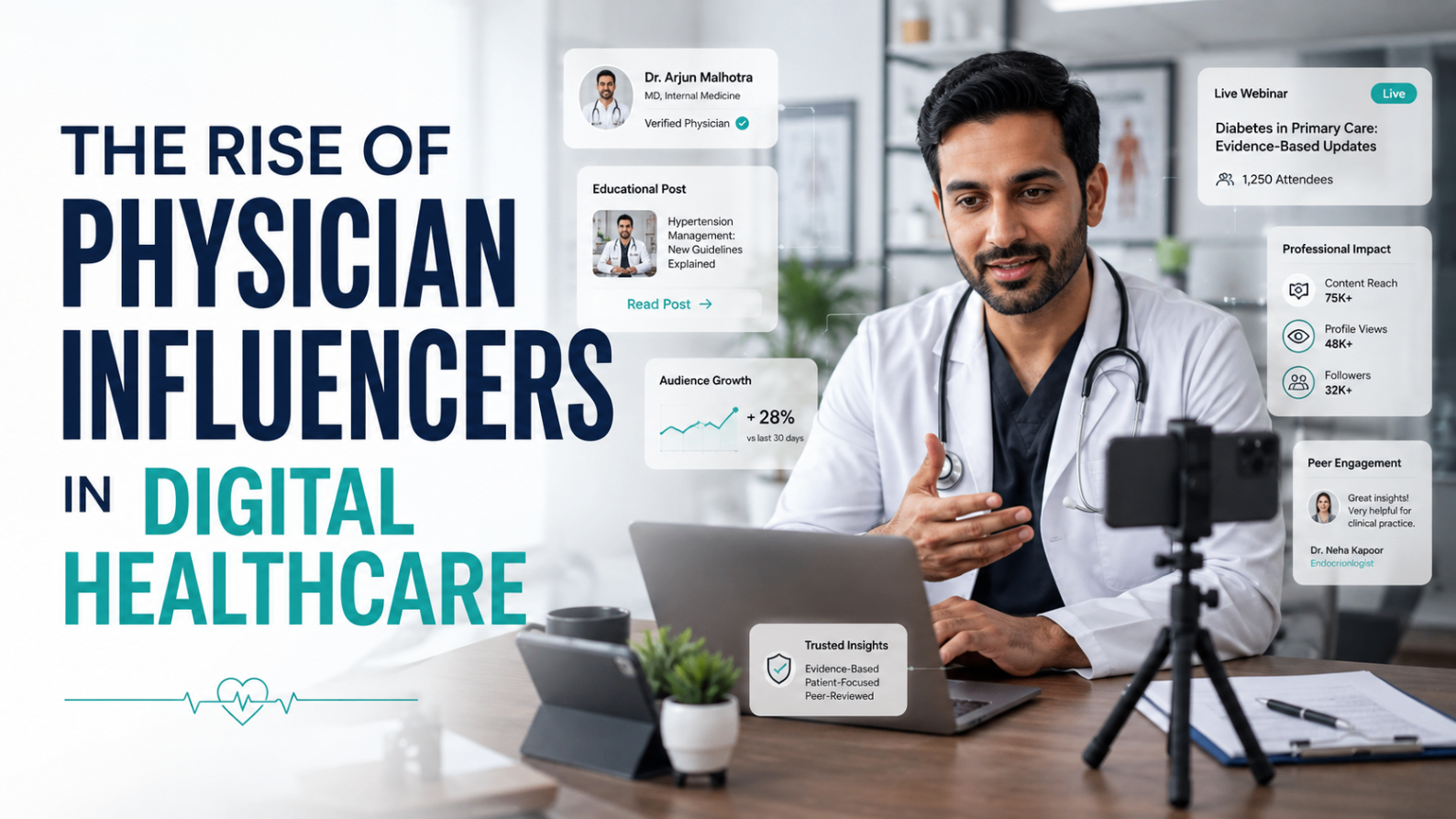
They are not primarily professional networking platforms, but they can make clinicians highly discoverable.
Physicians, nurses, therapists, pharmacists, and other professionals use short-form content to:
Explain health concepts
Address misinformation
Humanize healthcare
Share professional experiences
Build public-facing brands
Connect with other healthcare creators
The benefit is enormous potential reach.
The downside is that popularity does not necessarily equal professional value.
Someone can have 200,000 followers and still have a weaker professional network than a physician with 500 carefully chosen industry relationships.
Best for: Public education, creator branding, audience building, and visual storytelling.
Facebook's strongest healthcare networking feature is often not the public feed.
It is groups.
Specialty-specific physician groups, nursing groups, residency groups, local medical communities, practice management communities, and professional associations can create useful environments for discussion.
The quality varies substantially, however.
A carefully moderated group of 2,000 relevant healthcare professionals may be more valuable than a loosely moderated community containing 100,000 members.
Best for: Peer support, local communities, professional groups, and specialty-based discussion.
Before joining another network, ask one simple question:
If your primary goal is career advancement, LinkedIn and Doximity may deserve attention.
If your goal is healthcare-specific community building and interdisciplinary healthcare networking, MedSocially is particularly relevant.
If you want physician-to-physician conversation, consider Sermo.
If you want public visibility, Instagram and TikTok may be useful.
If you want specialty peer support, healthcare communities, MedSocially, and well-moderated professional groups may offer stronger value.
Most professionals do not need seven active accounts.
Two carefully selected platforms are often enough.
For example:
LinkedIn + MedSocially can be a strong combination.
LinkedIn provides exposure across the broader professional world.
MedSocially provides a healthcare-native environment for connecting with people and communities specifically interested in medicine, wellness, research, healthcare innovation, and professional collaboration.
Healthcare professionals face responsibilities that ordinary creators do not.
The HIPAA Privacy Rule protects individually identifiable health information when handled by covered entities and business associates, while the Security Rule establishes safeguards for electronic protected health information.
The American Medical Association also advises physicians to respect patient privacy and confidentiality and not publish patient information online without appropriate consent.
A few practical rules matter:
Never assume a private group automatically makes patient information safe to share.
Remove potentially identifying patient details.
Follow your employer's social media policies.
Understand a platform's privacy controls.
Keep professional boundaries in mind.
Remember that screenshots can turn "private" conversations into public ones.
A platform describing itself as HIPAA-aware or privacy-focused does not eliminate the healthcare professional's own responsibilities.
Finally, remember why you joined.
Healthcare networking is not a numbers game.
Five valuable professional relationships can be worth far more than 5,000 passive followers.
Complete your profile. Follow people relevant to your specialty. Join useful communities. Comment thoughtfully. Share things worth reading. Help colleagues. Ask intelligent questions. Participate consistently.
Then measure outcomes that actually matter:
Did you meet a mentor?
Did someone invite you to collaborate?
Did you discover useful research?
Did you connect with another specialist?
Did you find a career opportunity?
Did a discussion teach you something that changed your practice?
Those are meaningful networking metrics.
There is no single social media platform that is perfect for every healthcare professional.
LinkedIn excels at broad professional networking. Doximity provides a strong U.S. clinician network. Sermo facilitates peer discussion. Instagram and TikTok offer tremendous public reach. Facebook groups can create tightly focused communities.
But professionals increasingly need something more specialized as well.
MedSocially represents a newer generation of healthcare social media platform built specifically around the health ecosystem, bringing professionals, healthcare communities, discussion, educational content, events, and networking into one environment. Its support for doctors and clinicians, researchers, healthcare organizations, industry professionals, wellness experts, and wider health communities makes it especially relevant for interdisciplinary healthcare networking.
The goal should not be to be everywhere.
The goal is to be where the right healthcare conversations are happening.
Choose the platform that matches your professional goals, protect patient privacy, contribute genuinely to the community, and focus on relationships rather than reach.
Because the most valuable healthcare network is not necessarily the biggest one.
It is the one that connects you to the people who can help you learn, collaborate, grow, and ultimately improve healthcare.
From the very beginning of medicine, it has been a community enterprise. The formal learning of young doctors long before the advent of digital platforms was through rounds, con...
Healthcare communication doesn't just occur in the clinic, hospital, medical conference, or the academic journal. It's ubiquitous on social media, podcasts, video platforms, new...