Nurses spend much of their day moving between patient care and administrative work.
One moment they are speaking with a patient, checking symptoms, or explaining a care plan. The next, they may be searching through the electronic health record, reviewing medications, documenting vital signs, or trying to find the right piece of information buried somewhere in the chart.
Those transitions may seem routine, but they add up.
For many nurses, documentation and chart review continue after the shift ends. That means less time focused on patients during the day and more time finishing administrative work later.
Oracle Health is now trying to address some of that burden with an AI tool designed specifically for nursing workflows.
The company recently announced that its Oracle Health Clinical AI Agent, which has already been used by physicians in the United States, is now available to nurses.
The goal is straightforward: help nurses spend less time navigating the EHR and more time providing care.
One of the more practical features of the Clinical AI Agent is natural language chart navigation.
Instead of clicking through multiple sections of a patient record, nurses can use voice commands to find information.
That could make a meaningful difference during a busy shift.
A nurse caring for several patients may need to quickly review recent lab results, medications, previous notes, or relevant clinical history. Traditional chart review can require multiple steps. With an AI assistant embedded into the system, some of those searches can be completed through conversation.
The agent can also create summaries of relevant information in the patient's chart.
Rather than reading through every available note, a nurse could use the summary to get a faster understanding of the patient's current condition and recent clinical activity.
This does not eliminate the need for clinical review or judgment. It simply changes how quickly nurses can get to the information they need.
Documentation is another area where Oracle Health is applying AI.
The agent allows nurses to enter structured information through voice. That may include information such as a patient's weight, blood pressure, symptoms, or other discrete data points.
Instead of waiting until later to enter information manually, the nurse can document certain findings while care is happening.
That could help reduce one of the most persistent frustrations in nursing: having to remember details from multiple patient interactions and then enter them into the EHR later.
Voice based documentation is not entirely new, but its integration into existing clinical systems is becoming more sophisticated.
The important question is whether it can fit naturally into nursing work without becoming another technology that requires extra steps.
Healthcare organizations and technology companies are increasingly looking at nursing as the next major area for clinical AI.
Lifepoint Health, for example, recently began testing ambient technology that can listen during conversations between nurses and patients and generate documentation from those interactions.
The organization is also exploring AI agents that could potentially help nurses organize or prioritize patient assignments before a shift begins.
Hippocratic AI has taken a different approach with its Nurse Co-Pilot voice assistant. That system can communicate with patients and caregivers about topics such as medications, discharge preparation, and follow-up care. Documentation from those interactions can then be added to the clinical record.
These examples show that nursing AI is already moving in several directions.
Some tools focus on ambient documentation. Others focus on patient communication, workflow coordination, or administrative support.
Oracle Health's strategy stands out for another reason.
Oracle Health's Clinical AI Agent is built directly into the Oracle Health Foundation EHR.
That matters because one of healthcare's biggest technology problems is fragmentation.
A hospital may have an excellent AI tool, but if nurses have to open a separate application, sign in again, move information between screens, and learn a completely new workflow, the tool can create additional friction instead of removing it.
Oracle's approach is designed to minimize that problem.
Because the agent is embedded into the EHR, nurses can use AI within an environment they already work in rather than constantly moving between separate platforms.
This idea of reducing context switching may ultimately prove more important than any single AI feature.
Healthcare workers do not necessarily need more software.
They need the software they already use to become easier.
Another important part of the system is that the nurse remains responsible for the final documentation.
The Clinical AI Agent can generate or capture information, but nurses can review and approve what is entered into the medical record.
That human review is especially important in clinical environments.
AI can make documentation faster, but speed alone is not enough. Clinical notes influence communication, treatment decisions, quality reporting, billing, and patient safety.
A system that saves time but introduces incorrect information would create a different set of problems.
Keeping nurses involved in reviewing the final output allows AI to function more like an assistant than an autonomous decision maker.
Oracle Health's move reflects a broader shift in healthcare AI.
The conversation is moving beyond whether AI can generate clinical documentation. The bigger question is whether it can improve the way clinicians interact with technology throughout the day.
For nurses, that means reducing unnecessary searches, repetitive data entry, and administrative interruptions.
The most valuable AI tools may not be the ones with the most impressive demonstrations. They may be the ones nurses barely notice because they quietly remove friction from everyday work.
Oracle Health's Clinical AI Agent is another step in that direction.
Its real success, however, will not be measured by how much AI it uses.
It will be measured by something much simpler: whether nurses get meaningful time back to spend with their patients.
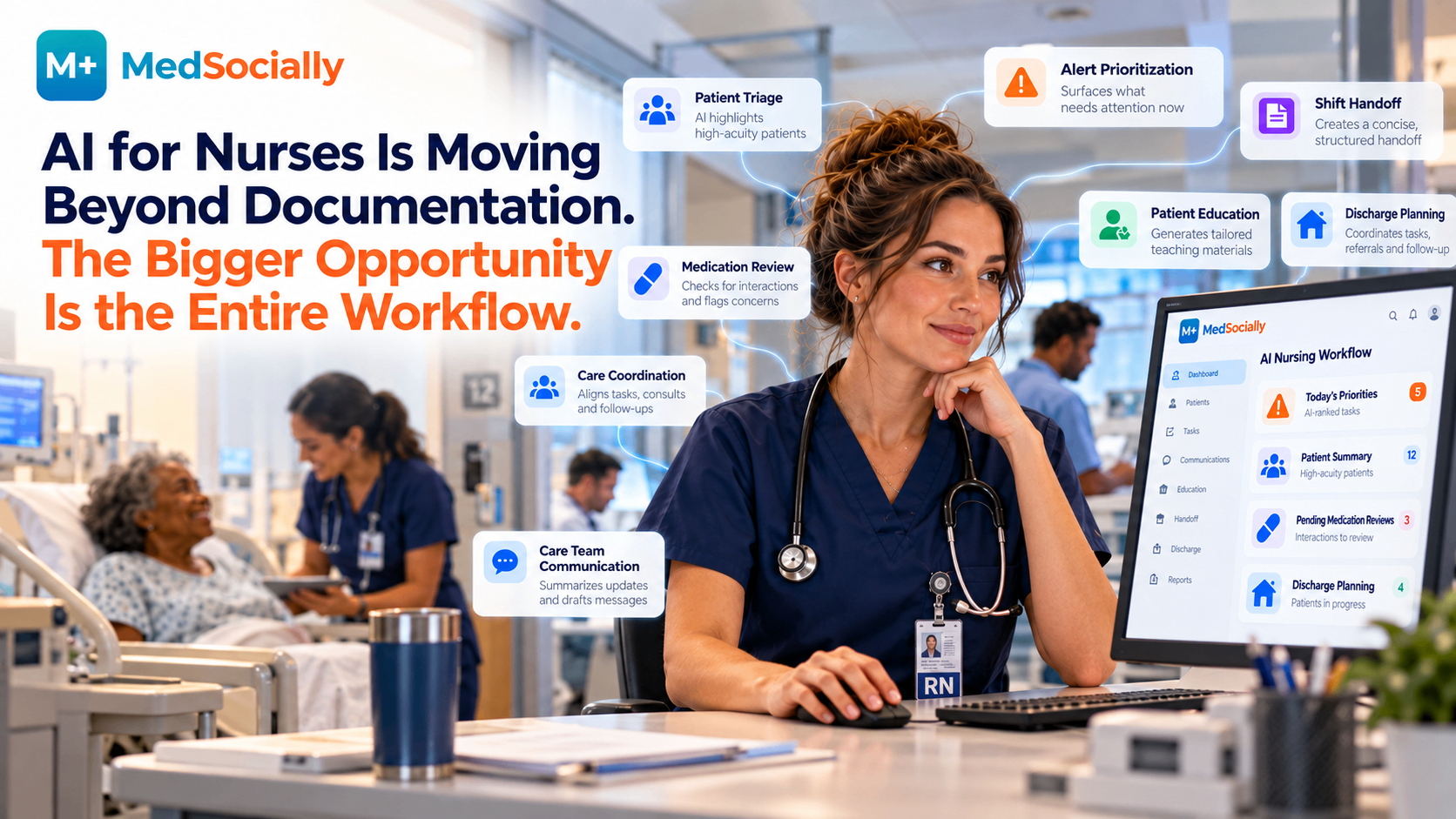
AI for nurses is quickly moving beyond simple documentation support.
What makes Oracle Health’s approach especially notable is that the AI agent is built directly into the EHR environment nurses already use. That may sound like a technical detail, but in practice it could be one of the most important features.
Healthcare workers already deal with too many disconnected systems. Adding another standalone tool can create more friction, even when the technology itself is useful.
The real opportunity is to make existing workflows easier.
If nurses can find information faster, document in real time, and move through the chart with fewer clicks, AI could become less of an added technology layer and more of a practical assistant.
That is where the value will ultimately be judged.
Not by how advanced the AI sounds, but by whether it helps nurses spend less time navigating technology and more time caring for patients.
Social media is no longer just a place where healthcare practices announce new office hours or post a photo on National Nurses Week. For many patients, it has become part ...
For millions of people, coffee is part of the daily routine. It starts the morning, fills the gap between meetings and often provides a small moment of comfort during a busy day...