Artificial intelligence is quickly becoming part of everyday healthcare. For nurses, however, the most important question may not be whether AI arrives at the bedside. It is what happens when it gets there.
Will nurses end up with another collection of apps, alerts, dashboards, and logins competing for their attention? Or could AI finally reduce some of the digital friction that has followed healthcare workers for years?
That distinction matters.
Nurses already spend a significant portion of their shifts interacting with technology. Electronic health records were supposed to make information easier to access, improve communication, and streamline documentation. In many hospitals, they accomplished some of those goals. But they also created new administrative demands.
A 2025 Black Book Research survey found that 92% of nurses felt EHR systems had negatively affected job satisfaction. Respondents also reported spending around 40% of their shifts documenting rather than providing direct patient care.
This helps explain why ambient documentation has attracted so much attention.
Healthcare's early experience with ambient AI has largely focused on physicians. These systems can listen during a clinical encounter and generate draft documentation, allowing clinicians to spend less time typing into the medical record.
The early evidence has been encouraging.
One study published in JAMA Network Open reported that physician burnout declined from 51.9% to 38.8% following the use of ambient AI scribes. Researchers also found improvements in documentation burden, cognitive workload, after-hours work, and the ability to focus on patients.
It was only a matter of time before attention moved toward nursing.
Nursing documentation is extensive, repetitive, and deeply tied to patient care. Nurses document assessments, intake and output, medications, mobility, skin findings, care plans, education, and countless other details throughout a shift.
Allowing a nurse to document parts of that work through natural conversation could save meaningful time.
But documentation is only one piece of the nursing workflow.
And that may be where the larger opportunity begins.
Consider how many systems a nurse might interact with during one shift.
There is the EHR. There may be separate systems for communication, dietary requests, equipment problems, interpreter services, policies, staffing, patient education, and room controls.
Each task may seem small on its own.
Checking an order might take a minute. Reporting a broken workstation might take a few more. Finding the latest protocol for a nasogastric tube could require another login and several clicks.
Multiply those interruptions across several patients and a 12-hour shift, and the burden becomes much larger.
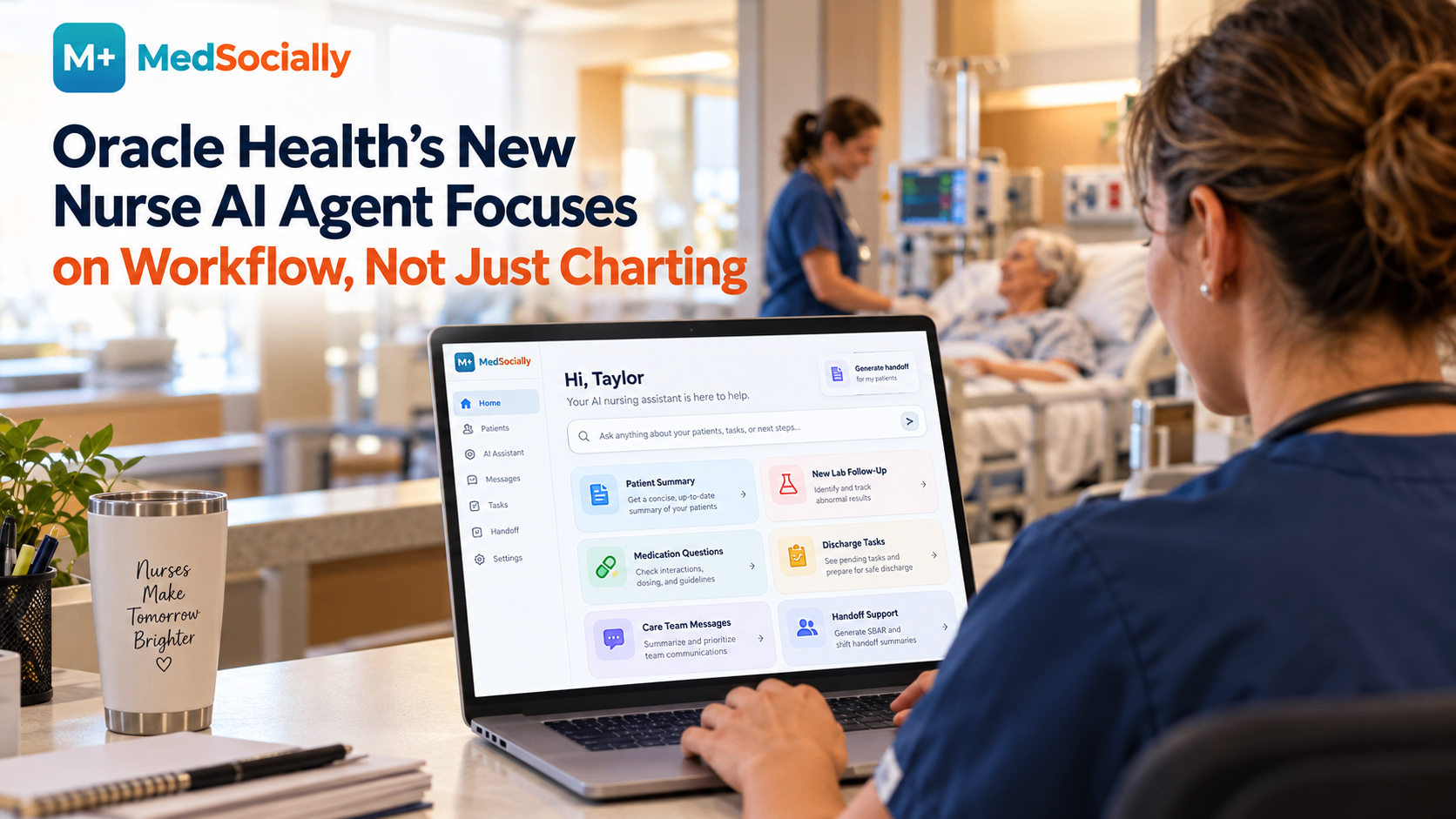
This is where conversational AI could become more interesting than ambient charting alone.
Imagine a nurse caring for a patient in room 304. Instead of opening several programs, the nurse could speak naturally:
The patient has been repositioned. They ate about half of lunch. The workstation in the room is malfunctioning. I also need the hospital's current NG tube replacement protocol.
An intelligent interface could potentially separate those requests and route each one to the appropriate system. The repositioning and nutrition information could go to the medical record. The equipment issue could generate a service request. The protocol could be retrieved from the hospital's approved clinical knowledge source.
The nurse interacts with one assistant rather than three or four separate systems.
That changes the role of AI.
It stops being another destination nurses have to visit and becomes a layer connecting the technology already surrounding them.
There is a risk that healthcare organizations repeat an old mistake.
Every department recognizes a problem, purchases another solution, and adds another interface to the clinical environment.
Eventually, nurses are surrounded by technology designed to make their jobs easier while spending more time managing the technology itself.
AI could easily follow the same path.
Hospitals may introduce one AI tool for documentation, another for staffing, another for messaging, another for education, and another for patient communication.
Individually, each product may work well. Collectively, they could create another fragmented ecosystem.
The more ambitious vision is a single conversational layer connecting those systems.
We already accept this idea in consumer technology. Someone using a smartphone does not want a separate voice assistant for maps, messaging, phone calls, reminders, and music. They expect one interface to understand what they want and communicate with the appropriate application.
Nursing technology could eventually move in a similar direction.
A nurse could communicate with one AI assistant while the underlying system interacts with the EHR, work-order software, clinical protocols, interpreter services, dietary systems, secure messaging, virtual nursing platforms, and even smart room devices such as lighting or temperature controls.
The potential is significant, but healthcare should be careful about defining success.
An AI nursing assistant should not be considered successful simply because a hospital deployed it or because it can generate documentation quickly.
The real question is much simpler.
Does it make the nurse's day easier?
Does it reduce unnecessary clicks? Does it eliminate duplicate work? Does it help nurses find information faster? Does it decrease time spent moving between systems? Most importantly, does it return meaningful time to patient care?
Nurses do not need technology simply because it uses artificial intelligence. They need technology that understands how nursing actually works.
That requires healthcare organizations and technology companies to design these systems with nurses, not merely for them.
Ambient documentation may be the most visible starting point, but it is unlikely to be the final destination.
The bigger opportunity is an AI assistant that quietly connects the fragmented pieces of a nurse's workflow.
If healthcare gets that right, the most valuable feature of nursing AI may not be what it can generate.
It may be everything nurses no longer have to stop caring for a patient to do.
Social media is no longer just a place where healthcare practices announce new office hours or post a photo on National Nurses Week. For many patients, it has become part ...
For millions of people, coffee is part of the daily routine. It starts the morning, fills the gap between meetings and often provides a small moment of comfort during a busy day...